SECURE Act 2.0: Retirement Planning Updates 2025 & Beyond

The SECURE Act 2.0 significantly reforms retirement savings, adjusting required minimum distributions, expanding catch-up contributions, and enhancing employer-sponsored plans to improve financial security for Americans.
As we approach 2025, understanding the SECURE Act 2.0: Key Retirement Planning Updates for 2025 and Beyond becomes paramount for anyone looking to secure their financial future. This landmark legislation, building upon the original SECURE Act, introduces a series of modifications designed to enhance retirement savings opportunities, simplify plan administration, and provide greater flexibility for American workers and retirees. Navigating these changes effectively can significantly impact your long-term wealth accumulation and distribution strategies.
The Evolution of Retirement Savings: A Look at SECURE Act 2.0
The SECURE Act 2.0, signed into law in late 2022, represents a comprehensive overhaul of existing retirement laws, aiming to address the evolving needs of an aging workforce and the challenges of modern retirement planning. Its provisions are being phased in over several years, with many critical changes taking effect in 2025 and beyond. This legislation seeks to make it easier for individuals to save for retirement, whether through employer-sponsored plans or individual retirement accounts, and to ensure that those savings last throughout their golden years.
The original SECURE Act (Setting Every Community Up for Retirement Enhancement) of 2019 laid the groundwork by making several key adjustments, such as increasing the age for required minimum distributions (RMDs) and allowing long-term part-time workers to participate in 401(k) plans. SECURE Act 2.0 expands upon these foundational changes, introducing even more significant shifts that demand attention from both financial professionals and individual savers.
Key Objectives of the Legislation
The core objectives of the SECURE Act 2.0 are multifaceted, designed to tackle various aspects of retirement insecurity and encourage proactive savings. These objectives reflect a broader understanding of the economic landscape and demographic shifts.
- Increasing Retirement Savings: By making it easier to save, the act aims to boost overall retirement readiness across the population.
- Simplifying Plan Administration: Reducing the administrative burden for employers can encourage more small businesses to offer retirement plans.
- Enhancing Flexibility: Providing more options for accessing and utilizing retirement funds, especially in emergencies, adds a layer of financial resilience.
- Promoting Financial Literacy: Some provisions indirectly encourage greater engagement with financial planning and education.
Ultimately, the SECURE Act 2.0 is a legislative effort to strengthen the American retirement system, making it more robust and adaptable to future economic conditions and individual needs. Its impact will be felt by millions, necessitating a clear understanding of its various components.
Required Minimum Distributions (RMDs): Adjustments and Implications
One of the most widely discussed aspects of the SECURE Act 2.0 concerns the rules surrounding Required Minimum Distributions (RMDs) from retirement accounts. These are the mandatory withdrawals that individuals must start taking from their traditional IRAs and 401(k)s once they reach a certain age. The new legislation continues the trend of pushing back this age, providing greater flexibility for retirees to defer income and allow their investments to grow longer.
The age at which RMDs begin has been progressively increased. The original SECURE Act moved the RMD age from 70½ to 72. SECURE Act 2.0 further pushes this age to 73, effective January 1, 2023, and then to 75, effective January 1, 2033. This incremental change offers a significant advantage for those who do not immediately need their retirement funds, allowing for extended tax-deferred growth.
Understanding the New RMD Age Thresholds
The staggered implementation of the RMD age increase means that different birth cohorts will be subject to different starting ages for their distributions. It’s crucial for individuals nearing retirement to understand which rule applies to them to avoid penalties for missed RMDs.
- If you were born in 1950 or earlier, your RMD age is 72.
- If you were born between 1951 and 1959, your RMD age is 73.
- If you were born in 1960 or later, your RMD age will be 75.
These adjustments underscore a legislative recognition that people are living longer and often working later in life, making it less necessary to draw down retirement savings at an earlier age. This flexibility can be a powerful tool in tax planning, allowing retirees to manage their taxable income more effectively.
Furthermore, the SECURE Act 2.0 also eliminates RMDs for Roth 401(k)s, aligning them with Roth IRAs. This change, effective January 1, 2024, means that Roth 401(k) participants will no longer be forced to take distributions from their employer-sponsored Roth accounts, allowing these funds to continue growing tax-free for their entire lifetime and potentially beyond, offering significant estate planning advantages. Understanding these RMD changes is fundamental for optimizing retirement income strategies.
Enhanced Catch-Up Contributions: Boosting Later-Life Savings
For individuals nearing retirement who may feel they haven’t saved enough, the SECURE Act 2.0 introduces significant enhancements to catch-up contribution limits. These provisions are designed to give older workers a greater opportunity to bolster their retirement savings in the years leading up to their planned retirement date. This recognition of varied savings journeys and the desire to provide a last-minute boost is a key feature of the new legislation.
Currently, individuals aged 50 and older can make additional catch-up contributions to their 401(k)s and IRAs above the standard limits. The SECURE Act 2.0 significantly increases these amounts for certain age groups, offering a substantial advantage for those who can afford to contribute more. These increased limits are particularly impactful for individuals in their late 50s and early 60s, who often have higher earning potential and fewer immediate financial obligations.
Specifics of the Increased Catch-Up Limits
The new legislation introduces a tiered approach to catch-up contributions, with the most significant increases for those closest to traditional retirement age. These changes are set to take effect gradually, allowing individuals and plan administrators time to adapt.
- Age 60-63 Catch-Up: For individuals aged 60, 61, 62, and 63, the catch-up contribution limit for 401(k), 403(b), and 457(b) plans will be increased to the greater of $10,000 or 50% more than the regular catch-up amount in 2025 (indexed for inflation).
- All Catch-Up Contributions as Roth: A critical change, effective in 2024, mandates that all catch-up contributions for those earning over $145,000 (indexed for inflation) must be made as Roth contributions. This means these contributions will be after-tax but qualified distributions in retirement will be tax-free.
These provisions offer a powerful incentive for older workers to maximize their savings, potentially closing any gaps in their retirement nest egg. The shift towards mandating Roth catch-up contributions for higher earners also has significant tax planning implications, favoring tax-free growth in retirement. Understanding these new limits and requirements is essential for optimizing late-career savings strategies.
Expanding Access to Retirement Plans: Small Business and Part-Time Workers
A significant focus of the SECURE Act 2.0 is on expanding access to employer-sponsored retirement plans, particularly for small businesses and part-time workers who have historically faced barriers. The legislation builds on the original SECURE Act’s efforts to encourage more employers to offer 401(k) plans, recognizing that workplace savings remain one of the most effective ways for individuals to accumulate retirement wealth.
For small businesses, the act introduces enhanced tax credits for starting new retirement plans or for automatically enrolling employees. These incentives aim to reduce the financial burden and administrative complexity associated with offering a retirement plan, making it a more attractive option for smaller employers. This is a crucial step towards leveling the playing field and ensuring that employees of businesses of all sizes have access to workplace savings opportunities.
Key Provisions for Broader Access
The legislation includes several specific measures designed to broaden the reach of retirement plans.
- Increased Startup Tax Credits: Small employers (up to 50 employees) can receive a tax credit for up to 100% of plan start-up costs, capped at $5,000, for the first three years. This is a substantial increase from previous limits.
- Auto-Enrollment Mandate: Most new 401(k) and 403(b) plans established after December 31, 2024, will be required to include an automatic enrollment feature, with an initial contribution rate of at least 3% (and up to 10%), increasing by 1% annually to a minimum of 10% (and up to 15%). This opt-out feature significantly boosts participation rates.
- Long-Term Part-Time Worker Rule Expansion: The original SECURE Act allowed long-term part-time workers (those working at least 500 hours for three consecutive years) to participate in 401(k)s. SECURE Act 2.0 reduces the service requirement to two consecutive years, effective in 2025, further expanding coverage.
These provisions are designed to bring more Americans into the retirement savings fold, ensuring that a wider segment of the workforce has access to the benefits of employer-sponsored plans. The push for automatic enrollment, in particular, is expected to have a profound impact on increasing overall savings rates by overcoming inertia.
Emergency Savings and Loan Provisions: New Flexibilities
Recognizing that unexpected financial emergencies often lead individuals to tap into their retirement savings prematurely, the SECURE Act 2.0 introduces new provisions designed to provide greater flexibility for accessing funds without incurring the typical penalties. These changes aim to support financial resilience, allowing individuals to address immediate needs without derailing their long-term retirement goals.
The legislation creates new avenues for emergency withdrawals and clarifies rules around plan loans, offering a safety net that could prevent individuals from taking drastic measures like cashing out their entire retirement account. This forward-thinking approach acknowledges the realities of personal finance and seeks to integrate emergency preparedness with long-term savings strategies.
Specific Emergency Withdrawal and Loan Rules
Several key provisions are designed to assist individuals facing unforeseen financial challenges.
- Penalty-Free Emergency Withdrawals: Effective in 2024, individuals can take one penalty-free withdrawal of up to $1,000 from their retirement account per year for emergency expenses. The withdrawal must be repaid within three years, and no further emergency withdrawals are permitted until the previous one is repaid.
- Employer-Sponsored Emergency Savings Accounts: Beginning in 2024, employers can offer emergency savings accounts linked to retirement plans. These accounts would be funded with after-tax Roth contributions, capped at $2,500, and fully liquid. Employers can auto-enroll employees into these accounts.
- Domestic Abuse Victim Withdrawals: Effective in 2024, individuals who are victims of domestic abuse can take a penalty-free withdrawal of up to the lesser of $10,000 (indexed for inflation) or 50% of their vested account balance.
These new flexibilities represent a significant shift in how retirement plans can be utilized, moving beyond strict long-term savings vehicles to incorporate elements of financial emergency preparedness. While offering valuable relief, individuals should still exercise caution and consider these options as a last resort, prioritizing the preservation of their retirement nest egg.
Student Loan Repayment and Retirement Contributions
One of the most innovative provisions of the SECURE Act 2.0, effective in 2024, addresses the significant burden of student loan debt and its impact on retirement savings. Many younger workers prioritize student loan payments over contributing to their 401(k)s, missing out on valuable employer matching contributions. The new legislation aims to bridge this gap, allowing individuals to receive employer matching contributions even if they are only making student loan payments.
This provision recognizes the financial realities faced by millions of Americans and seeks to remove a major barrier to retirement savings. By treating student loan payments as if they were elective deferrals for the purpose of employer matching, the act ensures that individuals are not penalized for managing their educational debt, thus promoting earlier participation in retirement plans.
How the Student Loan Matching Provision Works
The mechanism for this new benefit is straightforward but has profound implications for financial planning.
- Qualified Student Loan Payments (QSLP): Employers can amend their 401(k), 403(b), or 457(b) plans to allow matching contributions based on an employee’s qualified student loan payments.
- Matching Process: An employee makes student loan payments, and the employer treats these payments as if they were elective deferrals for the purpose of making a matching contribution to the employee’s retirement account.
- Eligibility: The employee must be eligible to receive matching contributions and make student loan payments.
This provision is a game-changer for younger generations burdened with student loan debt, enabling them to start saving for retirement earlier and benefit from employer matches that they might otherwise miss. It aligns retirement savings incentives with the realities of modern financial obligations, potentially fostering a stronger culture of long-term financial planning among those who are just starting their careers.
Planning for 2025 and Beyond: Actionable Steps
With numerous provisions of the SECURE Act 2.0 taking effect in 2025 and subsequent years, proactive planning is essential for both individuals and employers. The changes present both opportunities and challenges, requiring a careful review of current retirement strategies and potential adjustments to maximize benefits and ensure compliance.
For individuals, this means re-evaluating contribution strategies, understanding new RMD rules, and exploring the benefits of Roth accounts. For employers, it involves assessing plan design, communicating changes to employees, and ensuring administrative systems are updated to comply with new mandates. Staying informed and consulting with financial professionals will be key to navigating this evolving retirement landscape successfully.
Practical Advice for Maximizing Benefits
To effectively leverage the opportunities presented by the SECURE Act 2.0, consider these actionable steps:
- Review Your RMD Age: Confirm your specific RMD starting age based on your birth year and adjust your retirement income strategy accordingly. This allows for potentially longer tax-deferred growth.
- Maximize Catch-Up Contributions: If you are aged 50 or older, especially if you are in the 60-63 age bracket, explore increasing your catch-up contributions, keeping in mind the new Roth mandate for higher earners.
- Evaluate Roth Options: With the elimination of RMDs for Roth 401(k)s and the mandate for Roth catch-up contributions, consider the long-term tax benefits of Roth accounts for future tax-free income.
- Utilize Student Loan Matching: If your employer offers this provision and you have student loan debt, ensure you are taking advantage of employer matching contributions to boost your retirement savings.
- Understand Emergency Provisions: Familiarize yourself with the new penalty-free withdrawal options and emergency savings accounts, but remember they are intended for true emergencies to avoid depleting your long-term savings.
The SECURE Act 2.0 is not merely a set of rules; it’s a framework designed to empower individuals to build more secure financial futures. By engaging with these updates, you can optimize your retirement planning and ensure your savings strategy is aligned with the latest legislative landscape.
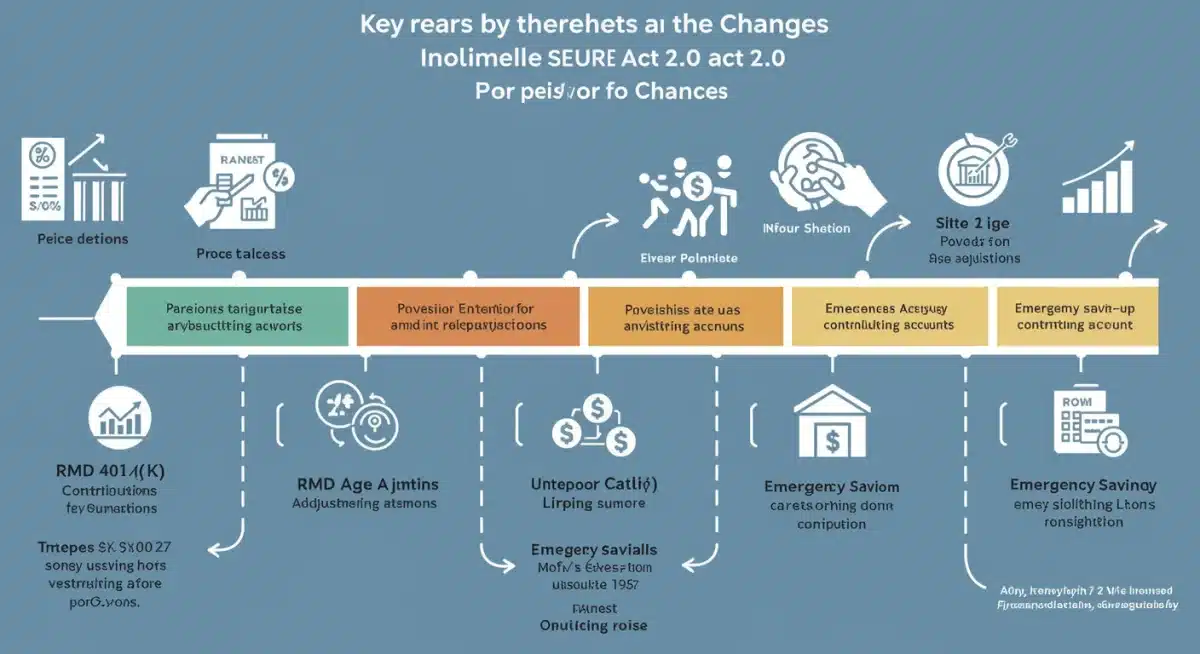
| Key Update | Brief Description |
|---|---|
| RMD Age Increase | RMD age pushed to 73 (2023) and 75 (2033), allowing longer tax-deferred growth. |
| Enhanced Catch-Up Contributions | Higher catch-up limits for ages 60-63, with Roth mandate for higher earners (2025). |
| Student Loan Matching | Employers can match retirement contributions based on employee student loan payments (2024). |
| Emergency Access | New penalty-free emergency withdrawals and optional emergency savings accounts (2024). |
Frequently Asked Questions About SECURE Act 2.0
The primary goal of the SECURE Act 2.0 is to enhance retirement savings for Americans by expanding access to retirement plans, simplifying administration, and offering greater flexibility in managing retirement funds. It aims to improve overall financial security and readiness for retirement across various demographics.
The Act increases the RMD age from 72 to 73 starting in 2023, and to 75 beginning in 2033. It also eliminates RMDs for Roth 401(k)s starting in 2024, aligning them with Roth IRAs and allowing for extended tax-free growth.
Yes, for individuals aged 60-63, catch-up contribution limits for 401(k)s will increase significantly in 2025. Additionally, starting in 2024, those earning over $145,000 must make all catch-up contributions as Roth contributions, impacting tax strategy.
Beginning in 2024, the SECURE Act 2.0 allows employers to make matching contributions to an employee’s retirement account based on their qualified student loan payments. This provision helps individuals save for retirement even while prioritizing student loan repayment.
The Act permits one penalty-free emergency withdrawal of up to $1,000 per year from retirement accounts, repayable within three years, starting in 2024. It also allows employers to offer optional emergency savings accounts linked to retirement plans, capped at $2,500.
Conclusion
The SECURE Act 2.0 represents a monumental shift in the landscape of retirement planning, offering a wealth of new opportunities and flexibilities for individuals and employers alike. From adjusting RMD ages and enhancing catch-up contributions to expanding access for small businesses and addressing student loan burdens, this legislation is designed to foster greater financial security for Americans. As we move into 2025 and beyond, understanding and strategically adapting to these changes will be crucial for optimizing retirement savings, navigating tax implications, and building a resilient financial future. Proactive engagement with these updates, potentially with the guidance of a financial advisor, will ensure that you are well-positioned to leverage the full benefits of the SECURE Act 2.0.