Federal Student Loan Repayment Options 2025: Key Updates

Effective January 2025, significant changes to federal student loan repayment options will impact millions of borrowers, offering new pathways to manage debt through revised income-driven repayment plans and enhanced benefits.
Navigating the landscape of student loan repayment can often feel like a complex maze, and with the recent updates, understanding your options is more crucial than ever. Recent Updates: Understanding New Federal Student Loan Repayment Options Effective January 2025 brings a fresh perspective to how borrowers will manage their educational debt. These changes are designed to provide greater flexibility and potentially lower monthly payments for a significant portion of federal student loan holders.
The Evolution of Federal Student Loan Repayment
The federal student loan system has undergone continuous evolution, aiming to address the growing burden of educational debt. These shifts reflect a broader effort to make higher education more accessible and manageable financially. Understanding this historical context helps to appreciate the significance of the upcoming changes.
Historically, repayment plans have ranged from standard fixed payments to various income-driven options. Each iteration has sought to balance the government’s role as a lender with the borrower’s ability to repay. The latest adjustments represent a significant step towards a more borrower-friendly environment, particularly for those with lower incomes or high debt-to-income ratios.
Key Milestones in Repayment Policy
- Income-Driven Repayment (IDR) Plans: Introduced to tie monthly payments to a borrower’s income and family size, these plans have been a cornerstone of federal student loan relief for decades.
- Public Service Loan Forgiveness (PSLF): A program designed to forgive remaining loan balances for those working in public service after 120 qualifying payments.
- COVID-19 Payment Pause: An unprecedented period of automatic forbearance and 0% interest that highlighted the need for more permanent, flexible solutions.
The upcoming changes are built upon these foundations, refining existing mechanisms and introducing new benefits that will shape the financial futures of millions. These updates are not merely minor tweaks; they represent a fundamental rethinking of how federal student loans interact with a borrower’s economic reality, particularly as we move into 2025.
Introducing the SAVE Plan: A Game Changer
The new Saving on a Valuable Education (SAVE) Plan is at the forefront of the recent updates: understanding new federal student loan repayment options effective January 2025. This plan is poised to replace the Revised Pay As You Earn (REPAYE) Plan and offers substantial improvements for many borrowers. The SAVE Plan aims to significantly reduce monthly payments and prevent interest capitalization, making it a potentially transformative option for those struggling with student debt.
The core philosophy behind the SAVE Plan is to ensure that a borrower’s monthly payment is truly affordable, based on their discretionary income. It redefines what constitutes discretionary income and lowers the percentage of that income used to calculate payments. This means more money stays in borrowers’ pockets, easing financial strain and promoting economic stability.
Key Benefits of the SAVE Plan
- Lower Monthly Payments: For undergraduate loans, payments are reduced from 10% to 5% of discretionary income.
- Interest Subsidy: If your monthly payment doesn’t cover the accrued interest, the government covers the remaining interest, preventing your loan balance from growing.
- Expanded Discretionary Income Definition: The amount of income protected from payment calculations is increased from 150% to 225% of the federal poverty line, significantly lowering payments for many.
These features combine to create a safety net for borrowers, ensuring that even if their income is low, their loan balance will not balloon due to unpaid interest. This is a crucial aspect of the SAVE Plan, as rising balances due to interest capitalization have been a major source of frustration and despair for many borrowers under previous IDR plans. The plan effectively puts a stop to the cycle of growing debt for those making their required payments.
Understanding Income-Driven Repayment (IDR) Plans in 2025
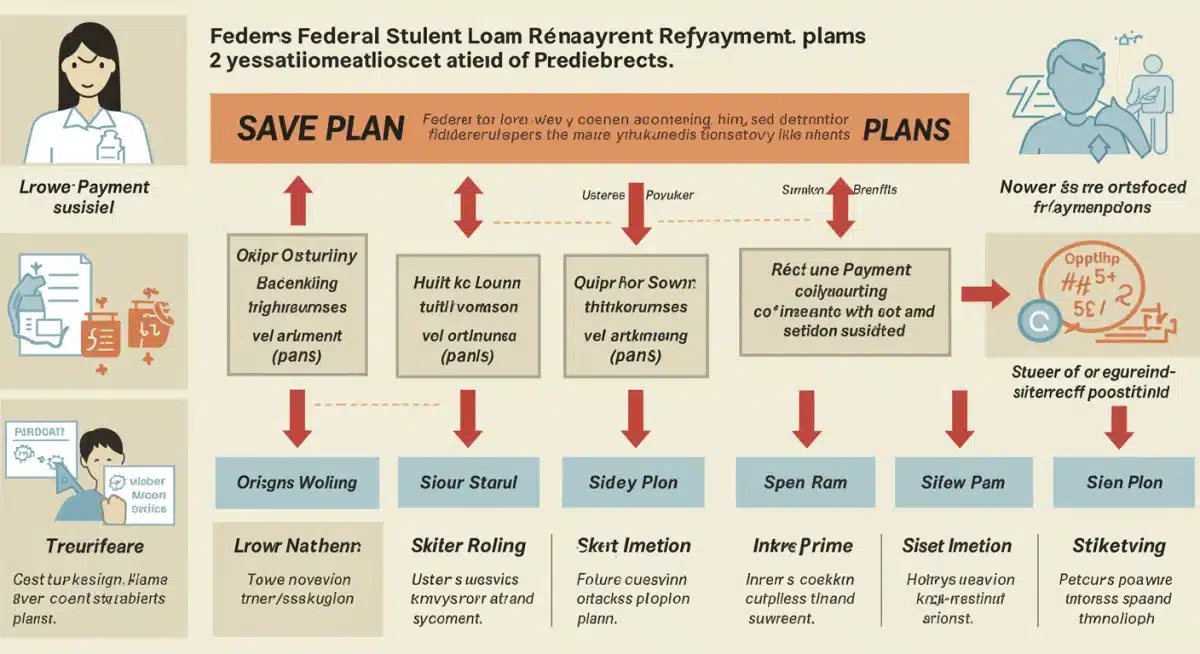
Beyond the SAVE Plan, the broader landscape of Income-Driven Repayment (IDR) plans is also being refined. These plans are designed to make loan repayment more manageable by adjusting monthly payments based on a borrower’s income and family size. The changes effective January 2025 will streamline and improve these options, offering clearer pathways to loan forgiveness.
The goal of IDR plans is to prevent default and provide a path to eventual loan forgiveness, typically after 20 or 25 years of qualifying payments. With the ongoing adjustments, the Department of Education seeks to make these plans more effective and accessible, ensuring that borrowers can truly benefit from their design.
One of the significant improvements involves addressing past administrative issues that prevented many borrowers from receiving credit for qualifying payments. The Department of Education is conducting a one-time adjustment to count more past periods of repayment toward IDR and PSLF forgiveness, which will be a huge relief for many long-term borrowers.
Available IDR Plans Moving Forward
- Pay As You Earn (PAYE): Payments are generally 10% of discretionary income, with forgiveness after 20 years.
- Income-Based Repayment (IBR): Payments are 10% or 15% of discretionary income, depending on when you took out your loans, with forgiveness after 20 or 25 years.
- Income-Contingent Repayment (ICR): Payments are either 20% of discretionary income or what you’d pay on a fixed 12-year plan, whichever is less, with forgiveness after 25 years.
It is important for borrowers to assess which IDR plan best suits their financial situation, as each plan has specific eligibility requirements and payment structures. The introduction of the SAVE Plan as the most favorable IDR option for many means that borrowers should actively compare it against other available plans to maximize their benefits.
Consolidation and Loan Forgiveness Opportunities
For many borrowers, understanding how consolidation impacts their repayment and forgiveness journey is critical. The recent updates: understanding new federal student loan repayment options effective January 2025 also bring clarity and expanded opportunities for loan consolidation, particularly for those seeking Public Service Loan Forgiveness (PSLF) or IDR forgiveness.
Consolidation allows borrowers to combine multiple federal student loans into a single Direct Consolidation Loan. This can simplify repayment by having only one monthly payment and one loan servicer. Crucially, consolidation can also make previously ineligible loans, such as Federal Family Education Loan (FFEL) Program loans, eligible for IDR plans and PSLF.
Strategic Consolidation for Forgiveness
Under the new rules, consolidating loans can potentially bring borrowers closer to forgiveness. The Department of Education’s one-time adjustment will count periods of repayment on consolidated loans towards IDR and PSLF forgiveness, even if those periods were prior to consolidation. This is a significant change that could accelerate forgiveness for many.
- Deadline for Consolidation: Borrowers with older loans, especially FFEL loans, should consider consolidating before the end of 2023 (though this deadline may extend or be subject to changes) to benefit from the one-time adjustment for IDR and PSLF.
- Weighted Average Interest Rate: Consolidated loans typically have a weighted average interest rate of the combined loans, rounded up to the nearest one-eighth of a percentage point.
- Impact on Forgiveness Timelines: Consolidating different types of loans can sometimes reset the forgiveness clock, but the one-time adjustment aims to mitigate this for eligible borrowers.
Borrowers must carefully evaluate their individual circumstances and, if necessary, seek professional advice before consolidating. While consolidation offers numerous benefits, it’s essential to understand its implications for interest rates and forgiveness timelines. The goal is to leverage these updates to achieve the most favorable outcome for your specific loan portfolio.
Navigating the Application Process and Eligibility
Applying for the new repayment options, especially the SAVE Plan, involves understanding the eligibility criteria and the necessary steps. The recent updates: understanding new federal student loan repayment options effective January 2025 emphasize a more streamlined application process, but borrowers still need to be diligent in providing accurate information.
Eligibility for IDR plans, including SAVE, is primarily based on your income and family size. Your loan servicer will use this information to calculate your monthly payment. It’s important to recertify your income and family size annually to ensure your payments remain accurate and affordable.
The Department of Education has been working to simplify the application forms and provide clearer guidance. Borrowers can usually apply or switch plans online through StudentAid.gov or by contacting their loan servicer directly. The key is to act proactively and not wait until payments are due to explore your options.
Steps to Apply for the SAVE Plan or other IDR plans
- Gather Financial Documents: You’ll need your most recent tax return or other proof of income, such as pay stubs.
- Visit StudentAid.gov: The official federal student aid website is the primary portal for managing your federal student loans.
- Complete the IDR Application: Select the option to apply for an income-driven repayment plan and choose the SAVE Plan if it’s the best fit for you.
- Annual Recertification: Remember to recertify your income and family size each year to maintain your eligibility and ensure your payments are correctly calculated.
For borrowers who are currently enrolled in REPAYE, the transition to the SAVE Plan should be automatic. However, it’s always wise to confirm this with your loan servicer. For those on other IDR plans or standard repayment plans, an active application will be required to switch to the SAVE Plan or another suitable IDR option. Being proactive ensures you take full advantage of these beneficial changes.
Impact on Different Borrower Groups
The recent updates: understanding new federal student loan repayment options effective January 2025 will have varying impacts on different borrower groups. While the changes are generally designed to be beneficial, certain demographics will experience more significant relief than others. Understanding these differential impacts can help borrowers anticipate how the new policies will affect their personal financial situations.
Lower-income borrowers and those with a high debt-to-income ratio are expected to benefit most from the SAVE Plan’s reduced monthly payments and interest subsidy. This group often struggles with the traditional repayment models, and the new plan offers a much-needed lifeline, preventing their loan balances from growing even when they cannot afford full payments.
Conversely, high-income earners with manageable debt might see less dramatic changes, as their payments under IDR plans could still be substantial. However, the interest subsidy can still be a benefit, even for those whose payments cover most of their interest, as it prevents any residual interest from capitalizing.
Who Benefits Most?
- Low-Income Borrowers: Will see significantly reduced monthly payments, potentially as low as $0, and no interest capitalization.
- Borrowers with Undergraduate Loans: Payments are cut from 10% to 5% of discretionary income, offering substantial relief.
- Public Service Workers: The one-time IDR adjustment and streamlined PSLF processes will accelerate forgiveness for many.
- Borrowers with Older FFEL Loans: Can consolidate to become eligible for the SAVE Plan and the one-time adjustment.
It’s also important to consider the impact on future borrowers. The enhanced IDR options, particularly the SAVE Plan, could make higher education more financially feasible by offering a clearer and more sustainable path to repayment. This could encourage more individuals to pursue degrees without the overwhelming fear of insurmountable debt. The overall goal is to create a more equitable and functional student loan system for all.
Preparing for January 2025: Actionable Steps
As January 2025 approaches, taking proactive steps is essential to fully leverage the recent updates: understanding new federal student loan repayment options effective January 2025. Being well-informed and organized can make a significant difference in your financial well-being and debt management strategy.
Start by reviewing your current loan portfolio. Understand the types of federal loans you hold, your current repayment plan, and your loan servicer. This foundational knowledge will be crucial for making informed decisions about whether to switch plans or consider consolidation. Don’t assume your current plan is the best option; actively compare it against the new offerings.
If you haven’t already, ensure your contact information with your loan servicer and on StudentAid.gov is up to date. This will ensure you receive important communications about the changes and any required actions. Missing critical updates could lead to missed opportunities or even penalties.
Essential Preparatory Actions
- Review Your Loan Details: Log in to StudentAid.gov to view all your federal student loans, their types, and current balances.
- Understand the SAVE Plan: Familiarize yourself with the specifics of the SAVE Plan and how it compares to your current repayment option. Use the loan simulator on StudentAid.gov.
- Contact Your Loan Servicer: If you have questions or need personalized advice, reach out to your loan servicer. They can provide guidance tailored to your situation.
- Consider Consolidation: If you have older loans (e.g., FFEL) or different types of federal loans, research if consolidation would benefit you, especially in light of the one-time adjustment.
- Annual Recertification Reminder: Set a reminder for your annual income and family size recertification to avoid payment increases or loss of benefits.
By taking these steps, you can position yourself to take full advantage of the new repayment options, reduce your financial burden, and move closer to achieving financial freedom from student debt. The changes are designed to help borrowers, but it’s up to each individual to understand and utilize them effectively.
| Key Update | Brief Description |
|---|---|
| SAVE Plan Launch | Replaces REPAYE, offering lower payments (5% of discretionary income for undergrads) and prevents interest capitalization. |
| Lower Payments | Undergraduate loan payments reduced to 5% of discretionary income, defined more generously. |
| Interest Subsidy | Government covers unpaid monthly interest if payment doesn’t cover it, preventing balance growth. |
| IDR Adjustment | One-time adjustment counts more past payments towards IDR and PSLF forgiveness, including consolidated loans. |
Frequently Asked Questions About Federal Student Loan Repayment
The SAVE Plan’s primary benefit is significantly lower monthly payments for many borrowers, especially those with lower incomes or undergraduate loans, and the prevention of interest capitalization, ensuring your loan balance doesn’t grow if you make your required payments.
Most federal student loan borrowers are eligible for the SAVE Plan, including those with Direct Loans. Borrowers with FFEL, Perkins, or other older federal loans may need to consolidate them into a Direct Consolidation Loan first to qualify.
If your calculated monthly payment under the SAVE Plan isn’t enough to cover the interest that accrues on your loan, the government will cover the remaining amount. This means your loan balance will not increase due to unpaid interest.
No, if you were enrolled in the REPAYE Plan, you will automatically be transferred to the SAVE Plan. However, it is always a good idea to confirm this transition with your loan servicer to ensure everything is processed correctly.
The one-time IDR adjustment reviews past payments and periods of deferment or forbearance to count them towards IDR and PSLF forgiveness. It benefits borrowers who have been in repayment for a long time, potentially accelerating their path to forgiveness.
Conclusion
The recent updates: understanding new federal student loan repayment options effective January 2025 represent a pivotal moment for millions of federal student loan borrowers across the United States. With the introduction of the SAVE Plan and significant enhancements to existing income-driven repayment and forgiveness programs, the landscape of student debt management is becoming more accessible and equitable. These changes aim to alleviate financial burdens, prevent interest growth, and provide clearer pathways to loan forgiveness, ultimately fostering greater financial stability for individuals and strengthening the broader economy. By actively engaging with these new options and preparing diligently, borrowers can harness these updates to their advantage, ensuring a more manageable and sustainable future for their educational debt.