Disability Benefits 2026: SSI & SSDI Eligibility with 2.5% Adjustment
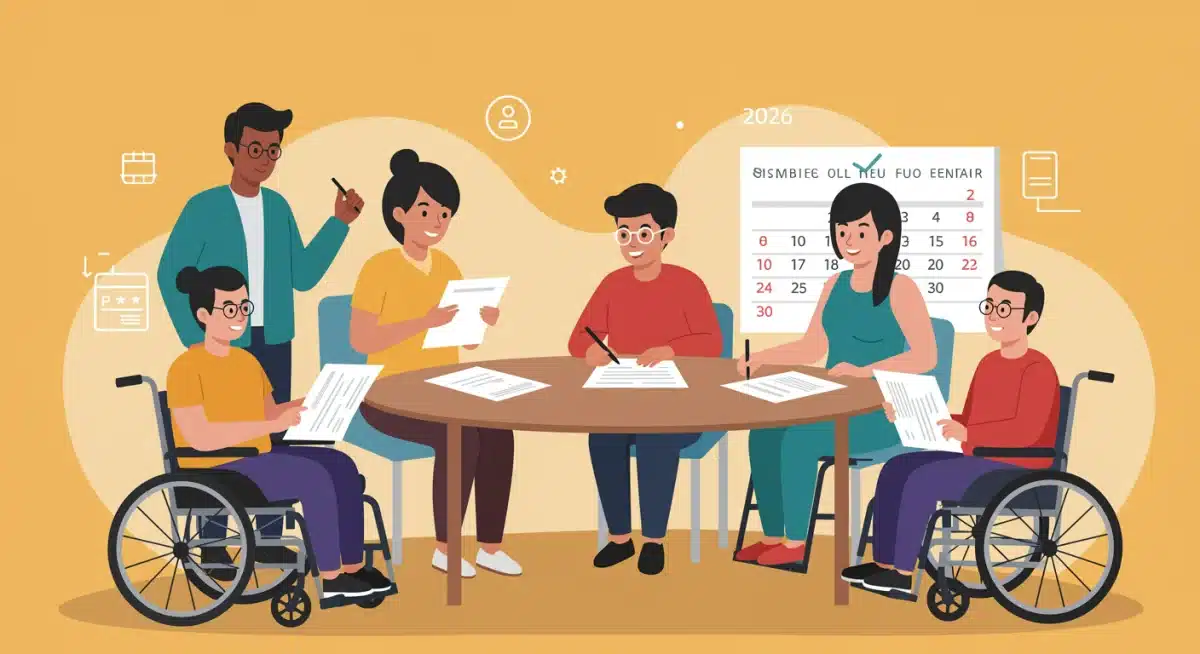
Disability Benefits 2026: Understanding SSI and SSDI Eligibility with a 2.5% Payment Adjustment
As we look ahead to 2026, millions of Americans relying on disability benefits are keenly interested in what the future holds. The landscape of Social Security Disability Insurance (SSDI) and Supplemental Security Income (SSI) is ever-evolving, with annual adjustments and potential policy changes impacting beneficiaries. This comprehensive guide will delve into the critical aspects of Disability Benefits 2026, focusing on eligibility criteria, the application process, and the anticipated 2.5% payment adjustment that could significantly affect your financial planning.
Understanding your rights and the nuances of these federal programs is paramount. Whether you are a current beneficiary, considering applying, or assisting a loved one, staying informed about the latest updates for Disability Benefits 2026 is crucial. We will explore the differences between SSI and SSDI, the stringent medical and non-medical requirements, and how the projected cost-of-living adjustment (COLA) might translate into real-world financial support.
The Foundation of Disability Benefits: SSI vs. SSDI in 2026
Before diving into the specifics of Disability Benefits 2026, it’s essential to grasp the fundamental distinctions between the two primary federal disability programs: Social Security Disability Insurance (SSDI) and Supplemental Security Income (SSI). While both are administered by the Social Security Administration (SSA) and provide financial aid to individuals with disabilities, their eligibility requirements and funding mechanisms differ significantly.
Social Security Disability Insurance (SSDI)
SSDI is an earned benefit program. It’s designed for individuals who have worked and paid Social Security taxes for a sufficient period. Think of it as an insurance policy you’ve been contributing to throughout your working life. In 2026, the core principle remains the same: eligibility hinges on your work history and the severity of your medical condition.
- Work Credits: To qualify for SSDI, you must have accumulated a certain number of work credits. These credits are earned by working and paying Social Security taxes. The number of credits required depends on your age when your disability began. Generally, you need 40 credits, with 20 of those earned in the last 10 years ending with the year your disability began. Younger workers may qualify with fewer credits.
- Medical Definition of Disability: The SSA has a strict definition of disability. To qualify for SSDI, you must have a medical condition that prevents you from engaging in any substantial gainful activity (SGA) and is expected to last for at least 12 months or result in death. This definition is uniform across both SSDI and SSI.
- Family Benefits: In some cases, certain family members of an SSDI beneficiary, such as spouses or dependent children, may also be eligible for benefits.
The amount of your SSDI benefit in Disability Benefits 2026 is based on your average lifetime earnings, not on the severity of your disability or your financial need. This means higher earners generally receive higher benefits, up to a maximum amount.
Supplemental Security Income (SSI)
SSI, unlike SSDI, is a needs-based program. It provides financial assistance to individuals who are aged (65 or older), blind, or disabled, and who have limited income and resources. You do not need a work history to qualify for SSI. Its purpose is to provide a minimum level of income for basic needs.
- Financial Need: The primary criterion for SSI is financial need. Your countable income and resources must fall below specific limits set by the SSA. These limits are subject to change annually based on inflation and other factors.
- Medical Definition of Disability: As with SSDI, you must meet the SSA’s strict definition of disability.
- Citizenship/Residency: Generally, you must be a U.S. citizen or national, or in certain categories of aliens, to qualify for SSI.
The maximum federal SSI benefit amount is also subject to annual adjustments, including the anticipated 2.5% payment adjustment for Disability Benefits 2026. Many states also supplement the federal SSI payment, so the total amount received can vary by location.
Eligibility Requirements for Disability Benefits 2026: A Deeper Dive
Navigating the eligibility criteria for Disability Benefits 2026 can be complex. The SSA employs a five-step sequential evaluation process to determine if an applicant meets the medical definition of disability. Understanding each step is crucial for a successful application.
Step 1: Are You Working? (Substantial Gainful Activity – SGA)
The SSA first checks if you are engaged in Substantial Gainful Activity (SGA). If you are working and your monthly earnings exceed a certain limit (which is adjusted annually and will be updated for Disability Benefits 2026), the SSA will generally find that you are not disabled, and your application will be denied. For non-blind individuals, the SGA limit for 2024 was $1,550 per month; for blind individuals, it was $2,590 per month. These figures will likely increase for 2026.
Step 2: Is Your Condition Severe?
If you are not engaged in SGA, the SSA will then consider if your medical condition is severe. A severe impairment is one that significantly limits your ability to do basic work activities, such as standing, walking, lifting, sitting, or remembering. Your condition must be expected to last for at least 12 months or result in death.
Step 3: Is Your Condition on the List of Impairments?
The SSA maintains a List of Impairments, often referred to as the "Blue Book." This list describes impairments that are considered severe enough to prevent an individual from engaging in any SGA. If your condition meets or equals one of the medical listings in the Blue Book, the SSA will find you disabled. This often expedites the approval process for Disability Benefits 2026.
Step 4: Can You Do the Work You Did Previously?
If your condition does not meet or equal a listing, the SSA will assess your residual functional capacity (RFC). This is a determination of your ability to perform work-related activities despite your limitations. The SSA will then compare your RFC with the demands of your past relevant work (PRW). If you can still perform your PRW, your application for Disability Benefits 2026 will likely be denied.
Step 5: Can You Do Any Other Type of Work?
If you cannot perform your PRW, the SSA will consider if there is any other type of work you can do, considering your age, education, past work experience, and RFC. They will consult with vocational experts to determine if you can adjust to other work that exists in significant numbers in the national economy. If the SSA determines you cannot perform any other work, you will be found disabled.
The Application Process for Disability Benefits 2026
Applying for Disability Benefits 2026 can be a lengthy and often challenging process. It requires meticulous documentation and often involves multiple stages of review. Here’s a general overview of what to expect:
Gathering Documentation
The most crucial step is compiling comprehensive medical evidence. This includes:
- Medical records from doctors, hospitals, clinics, and therapists.
- Laboratory test results (X-rays, MRIs, CT scans, blood tests).
- Treatment histories, including medications, surgeries, and therapies.
- Statements from treating physicians detailing your diagnosis, prognosis, and functional limitations.
You will also need personal information, such as your Social Security number, birth certificate, marriage certificate (if applicable), and detailed work history information.

Submitting Your Application
You can apply for Disability Benefits 2026 online, by phone, or in person at your local Social Security office. For SSDI, the SSA recommends applying online as it is often the quickest method. SSI applications generally require an in-person interview.
Initial Review by the SSA
Once your application is submitted, the SSA reviews it for non-medical eligibility (work credits for SSDI, income/resources for SSI). If you meet these criteria, your case is sent to a state agency, Disability Determination Services (DDS).
Medical Review by DDS
DDS is responsible for making the medical determination of disability. They will review all your submitted medical evidence. They may also contact your doctors, send you for a consultative examination (CE) with an independent doctor, or request additional information. This stage is critical and can take several months.
Appeals Process
Unfortunately, many initial applications for Disability Benefits 2026 are denied. If your application is denied, you have the right to appeal. The appeals process typically involves several stages:
- Reconsideration: Your case is reviewed by a different examiner at DDS.
- Hearing by an Administrative Law Judge (ALJ): If reconsideration is denied, you can request a hearing before an ALJ. This is often the most successful stage for applicants.
- Appeals Council Review: If the ALJ denies your claim, you can appeal to the SSA’s Appeals Council.
- Federal Court Review: As a last resort, you can file a lawsuit in federal district court.
It’s highly recommended to seek assistance from a qualified disability attorney or advocate, especially during the appeals process. They can help gather evidence, represent you at hearings, and significantly improve your chances of approval for Disability Benefits 2026.
Anticipated 2.5% Payment Adjustment for Disability Benefits 2026
One of the most significant updates beneficiaries look forward to annually is the Cost-of-Living Adjustment (COLA). For Disability Benefits 2026, experts are projecting an approximate 2.5% payment adjustment. While this is an estimate and the final COLA is determined by the Consumer Price Index for Urban Wage Earners and Clerical Workers (CPI-W) from the third quarter of the current year, it provides a valuable insight into potential future benefits.
What is COLA and How is it Calculated?
The COLA is an annual increase in Social Security and SSI benefits to help offset the effects of inflation. It ensures that the purchasing power of benefits is maintained over time. The increase is typically announced in October of each year and takes effect the following January.
The calculation is based on the rise in the CPI-W. If the CPI-W increases from the third quarter of the previous year to the third quarter of the current year, then benefits are increased by the same percentage. If there is no increase, there is no COLA.
Impact of a 2.5% Adjustment
A 2.5% payment adjustment for Disability Benefits 2026 would mean that if your current monthly benefit is $1,500, it would increase by $37.50, bringing your new monthly benefit to $1,537.50. While this might seem modest, for individuals on fixed incomes, even a small increase can make a significant difference in covering rising costs of living, such as groceries, utilities, and healthcare.

It’s important to remember that this adjustment applies to both SSDI and SSI benefits. However, for SSI beneficiaries, an increase in benefits could also potentially affect other needs-based programs they receive, as their total income might increase. It’s advisable for SSI recipients to understand how COLA impacts their overall benefits package.
Factors Influencing Disability Benefits in 2026
Beyond the COLA, several other factors can influence the amount and availability of Disability Benefits 2026. These include legislative changes, economic conditions, and individual circumstances.
Legislative and Policy Changes
Congress periodically reviews and amends Social Security laws. While no major structural changes are currently projected for Disability Benefits 2026, it’s always possible for new legislation to be introduced that could affect eligibility, benefit amounts, or the application process. Staying informed through official SSA channels and reputable news sources is crucial.
Economic Conditions
The broader economic climate can indirectly impact disability benefits. High inflation, for example, is the primary driver behind COLA adjustments. Economic shifts can also influence funding for state-specific supplementary programs for SSI beneficiaries.
Individual Circumstances
Your personal situation plays a massive role. For SSDI, returning to work, even part-time, can trigger a trial work period or cessation of benefits if your earnings exceed SGA limits. For SSI, changes in income, resources, living arrangements, or marital status must be reported to the SSA, as they can directly affect your monthly payment.
Maximizing Your Chances for Approval of Disability Benefits 2026
Successfully obtaining Disability Benefits 2026 requires a strategic approach. Here are some key tips to maximize your chances of approval:
- Seek Consistent Medical Treatment: Regular visits to doctors, specialists, and therapists are crucial. Your medical records are the backbone of your claim, so ensure they are thorough and up-to-date. Follow your doctor’s prescribed treatments and document any side effects or changes in your condition.
- Be Honest and Detailed in Your Application: Provide accurate and complete information about your medical conditions, symptoms, limitations, and work history. Do not exaggerate or minimize your symptoms.
- Document All Limitations: Beyond just diagnoses, clearly articulate how your condition impacts your ability to perform daily activities and work-related tasks. Keep a detailed diary of your symptoms and how they affect you.
- Understand the SSA’s Definition of Disability: Familiarize yourself with the five-step evaluation process. This will help you understand what information the SSA needs and how they will evaluate your claim.
- Consider Professional Assistance: A disability attorney or advocate can be invaluable. They understand the complex regulations, can help gather necessary evidence, communicate with the SSA on your behalf, and represent you at hearings. Statistics show that applicants with legal representation have a significantly higher success rate.
- Don’t Give Up After an Initial Denial: Many valid claims are initially denied. The appeals process is designed for this reason. Persist through the appeals, especially the ALJ hearing stage.
Common Misconceptions About Disability Benefits 2026
Several myths surround Disability Benefits 2026 that can often deter eligible individuals from applying or lead to misunderstandings. Let’s dispel some of these common misconceptions:
- Myth: You can only get disability if you are permanently unable to work.
Fact: The SSA’s definition of disability requires your condition to prevent SGA for at least 12 months or result in death. It doesn’t necessarily mean you can never work again, but rather that your current condition severely limits your ability to work. - Myth: It’s impossible to get approved for disability benefits.
Fact: While the process is stringent, millions of Americans receive SSDI and SSI benefits. A strong application with comprehensive medical evidence and, often, legal representation significantly increases your chances of approval. - Myth: You can work part-time and still receive full benefits.
Fact: This depends on your earnings. If your earnings exceed the SGA limit, your benefits may be affected or cease. However, there are work incentives programs like the Ticket to Work program that allow beneficiaries to test their ability to work without immediately losing benefits. - Myth: SSI and SSDI are the same program.
Fact: As discussed, SSI is needs-based with no work history requirement, while SSDI is an earned benefit based on your work history and Social Security tax contributions. - Myth: The SSA helps you get your medical records.
Fact: While the SSA will request records from your providers, it is ultimately your responsibility to ensure all necessary medical evidence is submitted. Proactively gathering your records can significantly speed up the process.
The Future of Disability Benefits: Beyond 2026
While our focus here is on Disability Benefits 2026, it’s worth noting that the Social Security system faces long-term financial challenges. Discussions about potential reforms are ongoing in Congress, often centered around ensuring the solvency of the trust funds for future generations. These discussions may involve changes to eligibility, benefit calculations, or the retirement age.
However, it is important to emphasize that any significant changes typically involve extensive debate and are not implemented suddenly. For the foreseeable future, the structure of SSDI and SSI is expected to remain largely consistent with the parameters outlined for Disability Benefits 2026.
Conclusion: Staying Informed for Disability Benefits 2026
Navigating the world of Disability Benefits 2026 requires diligence, patience, and a clear understanding of the rules and regulations. Whether you are seeking new benefits or are a current recipient, staying informed about eligibility criteria, the application process, and potential payment adjustments like the anticipated 2.5% COLA is essential.
The Social Security Administration provides vital financial lifelines to millions of Americans with disabilities. By preparing thoroughly, understanding the requirements for both SSI and SSDI, and seeking professional guidance when needed, you can better navigate the system and secure the support you are entitled to. Remember, your medical documentation is your strongest advocate, and persistence is key throughout the application and appeals process.
For the most accurate and up-to-date information regarding your specific situation and any changes to Disability Benefits 2026, always consult the official Social Security Administration website or contact them directly.